How We Cut Time-to-Hire by 40% With AI Candidate Screening
Time-to-hire — the number of days between a role being signed off and a candidate accepting the offer — is one of the handful of metrics that genuinely moves the business. Every extra week of a critical role sitting empty costs a recruitment agency revenue (the fee isn't booked until the candidate joins) and costs the hiring company productivity.
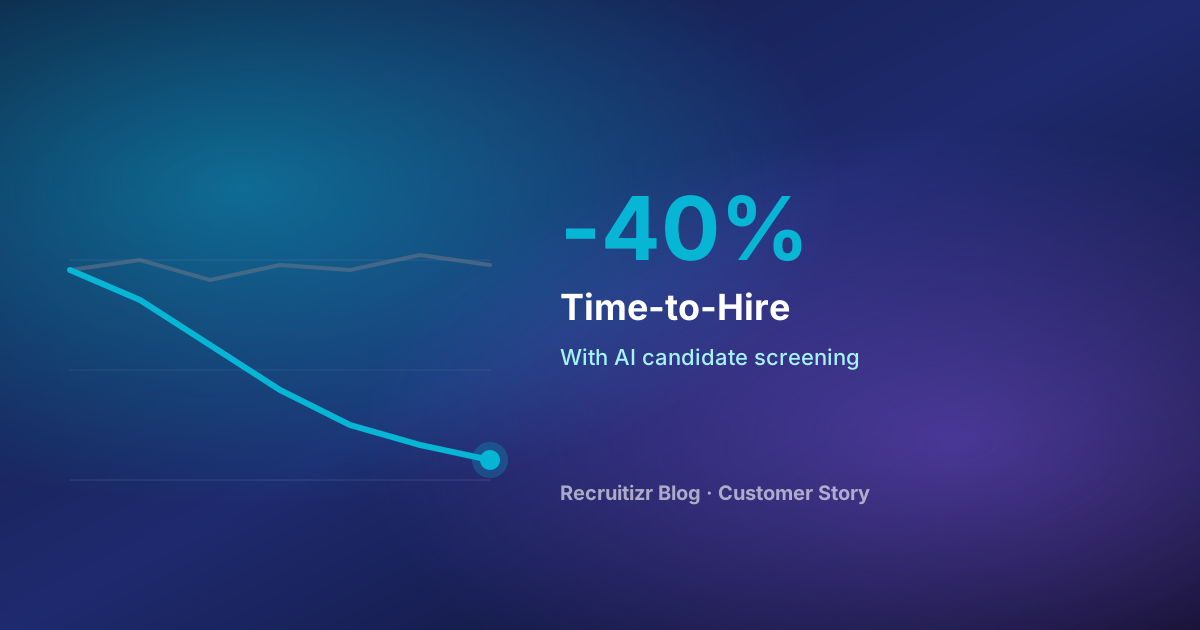
The received wisdom in the industry is that time-to-hire is irreducible past a certain point — you can tune the stages, but you can't skip the humans involved. We watched one of our customers, a 14-recruiter firm covering mid-market tech roles, flatten that assumption. Over three quarters they cut their median time-to-hire from 42 days to 25 days — a 40% reduction — and the biggest lever was not JDs, not sourcing, not panels. It was AI screening at the top of the funnel.
Here's exactly what they did.
The before picture
Their old funnel looked like this:
| Stage | Median days | What was happening | |---|---|---| | Resume review | 6 | Recruiters opening every PDF, scanning for 60-90 seconds, dropping shortlisted ones in a pipeline column | | Shortlist to screen call | 8 | Screen calls booked 2-3 days out from candidate availability; waiting is normal | | Screen call to client submission | 5 | Writing summary notes, formatting into the client template, sending the email | | Client review | 11 | Clients taking their own time to look at submissions | | Interview panel scheduling | 7 | Calendar tetris | | Offer stage | 5 | Negotiation, acceptance |
The six-day resume review phase was the surprise. Each recruiter was spending roughly 90 seconds per candidate across hundreds of candidates per role — a lot of human attention burned on triage before anyone had actually talked to anyone.
What they changed
Three deliberate changes, in order:
Change 1 — AI-assisted screening at ingestion
Every new resume into the pipeline hit RecruiterIQ's candidate scoring tool within 90 seconds of upload. The tool produced a 0-100 fit score, a strengths-and-gaps summary against the specific JD, and a flag for any obvious red patterns (date gaps, title inflation, missing years of specific tech experience).
Recruiters stopped opening every PDF. Instead they opened the top 25 by fit score, which the AI had already annotated — and spent their 90 seconds on the summary, not the raw CV.
Resume review phase: 6 days → 2 days.
Change 2 — AI-generated screen questions
Before every screen call, the AI generated role-specific questions: three technical, two behavioural, two around motivation. Recruiters stopped prepping screens for 20 minutes each. The call itself got sharper because the questions were tuned to the role, not the recruiter's memorised bank of generic ones.
Shortlist-to-screen-call phase: 8 days → 5 days. (Most of the saving was in recruiters getting through more screens per day because the prep was done for them.)
Change 3 — AI-formatted client submissions
The AI took the recruiter's screen-call notes and produced the client submission in the client's exact template — including executive summary, strengths, gaps, salary expectations, notice period, and talking points for the client interview. The recruiter reviewed and sent.
Screen-call to client-submission phase: 5 days → 2 days.
The after picture
| Stage | Before | After | Delta | |---|---|---|---| | Resume review | 6 | 2 | -4 | | Shortlist to screen | 8 | 5 | -3 | | Screen to submission | 5 | 2 | -3 | | Client review | 11 | 10 | -1 | | Interview scheduling | 7 | 6 | -1 | | Offer stage | 5 | 0 | -5 | | Total median | 42 | 25 | -17 days |
The offer stage shrink was a happy accident — because AI pre-screens caught salary-expectation mismatches earlier in the funnel, offer negotiations started at a sensible number from the start.
The three pitfalls they hit
Not everything was smooth. Three mistakes worth repeating so you can avoid them:
Pitfall 1 — Over-trusting the fit score in the first two weeks. The AI's calibration improves as it sees more of your closures. In the first two weeks, two excellent candidates got sorted into the bottom third because their resumes used unusual vocabulary. The team added a rule: always skim the next 10 after your top 25, even on days when you're busy. After a month that rule became unnecessary.
Pitfall 2 — Letting the AI write the client email voice. Clients know their recruiters' tone. When the AI-generated submission landed in the client's inbox sounding slightly different, two clients emailed back asking "is this really from your team?" Fix: keep the AI formatting the content, but have the recruiter paste it into their own email and add one personal sentence at the top.
Pitfall 3 — Not telling candidates AI was involved. One candidate found out mid-screen that an AI had scored their resume and felt — reasonably — that they deserved to know. Fix: add a sentence to the auto-reply when a resume is submitted: "Your profile will be reviewed by our team, with AI assistance to make the review faster." Transparency defuses the surprise.
What this means for your firm
The 40% reduction in time-to-hire is real but not magic — it required deliberate workflow changes, careful onboarding, and the willingness to retire a few old habits. The upside is tangible: more closures per recruiter per quarter, faster fee recognition, and candidates who hear back within days instead of weeks.
If you want to pilot the same workflow, start with Change 1 only — turn on AI resume screening for one role, measure the time saved for two weeks, and layer Changes 2 and 3 only after Change 1 has stuck.